

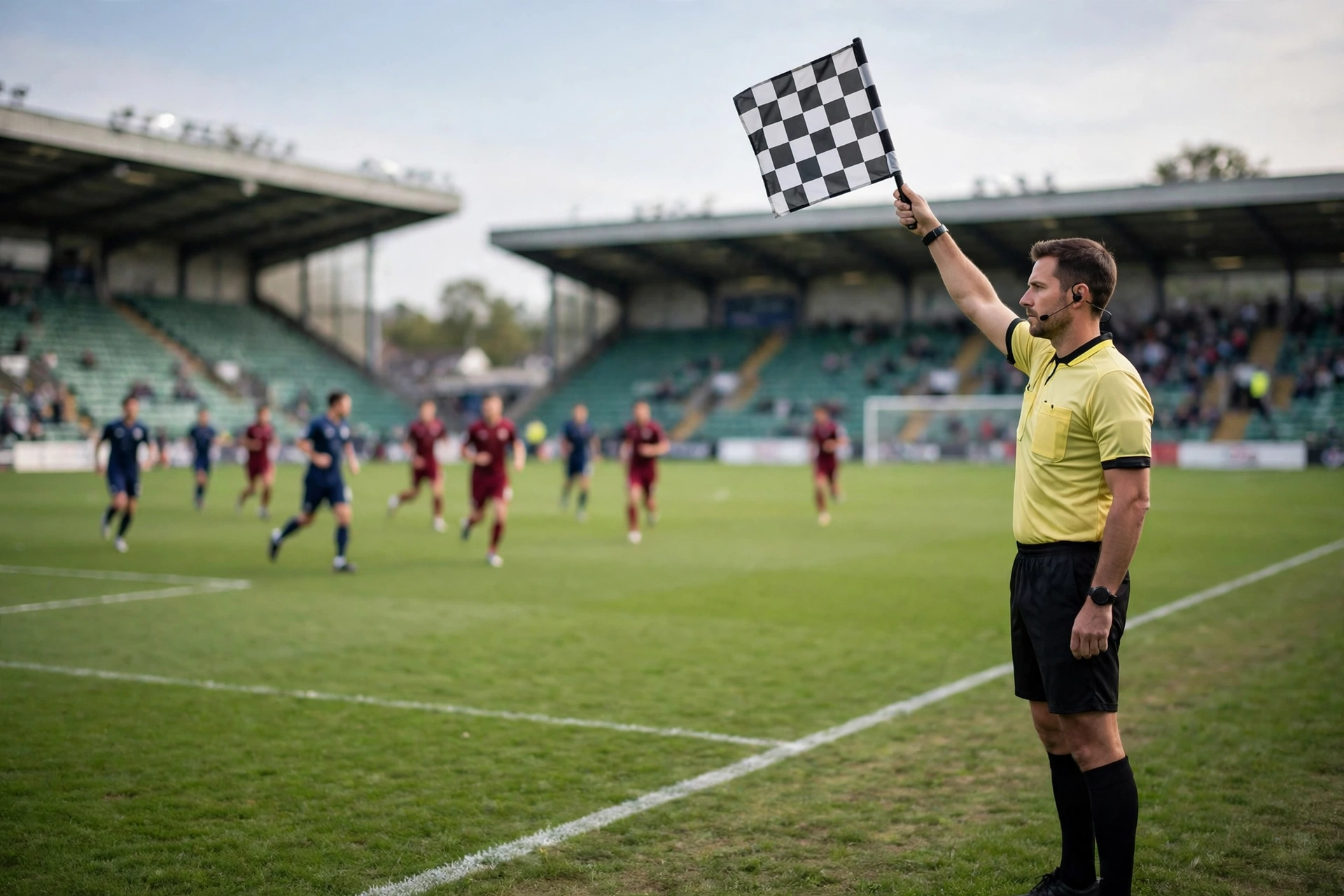
The offside rule in football explained badly can sound like a maths exam. Explained well, it takes about two minutes to understand. If you have ever watched a goal get ruled out and wondered why everyone is arguing, this guide is for you. We will keep it simple, use everyday examples, and by the end you will spot offsides before the flag goes up.
The Offside Rule in Football Explained in One Idea
Here is the core idea. A player is in an offside position if any part of their head, body or feet is in the opponents’ half and closer to the opponents’ goal than both the ball and the second-last opponent. In practice, the second-last opponent is almost always the goalkeeper plus one defender, or two defenders if the goalkeeper has come out.
Being in an offside position is not an offence by itself. It only becomes an offence when the ball is played to that player by a team-mate. The moment that matters is the moment the pass is kicked, not the moment the ball arrives. A player who was level with the second-last opponent when the pass was played is onside, even if the picture looks tight.
Simple Examples You Can Picture
Example one: imagine a striker standing right next to the goalkeeper, with no defender anywhere near, while the ball is out on the wing. A team-mate crosses the ball and the striker taps it in. That is offside, because when the cross was played, only the goalkeeper was between the striker and the goal.
Example two: a midfielder plays a through ball, and the striker starts her run from behind the last defender, level with him when the pass is kicked. She races past him and scores. That is onside and a perfectly good goal, because she was not beyond the second-last opponent when the ball was played.
Example three: think of it like a race rule. You are not allowed to wait at the finish line for someone to hand you the baton. You have to be in the fair zone when the baton starts moving towards you.
When You Cannot Be Offside
There are a few situations where the offside rule simply does not apply, and these catch a lot of new fans out.
You cannot be offside in your own half of the pitch, no matter how far forward you look. You also cannot be offside if you receive the ball directly from a goal kick, a throw-in or a corner kick. A clever player standing near the goal when a corner comes in is doing nothing wrong at all.
What Happens When a Player Is Offside?
When the assistant referee spots an offside offence, they raise their flag, the referee blows the whistle, and play restarts with an indirect free kick to the defending team from where the offence happened. No card, no penalty, just the ball handed over. An indirect free kick means the ball must touch another player before a goal can be scored from it.
Why Does the Offside Rule Exist?
Without the rule, football would be a very dull game. Attackers could simply stand next to the goalkeeper all match, waiting for long balls to be hoofed up to them. Defenders would have to stay back and guard them, and the midfield, where most of the skill and passing happens, would be empty. The offside rule forces teams to build attacks together, time their runs, and beat the defence with clever movement rather than goal-hanging.
What About VAR?
In top leagues, the video assistant referee, known as VAR, checks tight offside calls using camera angles and drawn lines. This has made decisions more accurate, but also more controversial, because goals are now sometimes ruled out by the width of a toe or an armpit. The rule itself has not changed; it is just being measured far more precisely than it ever was by the human eye.
Once you understand the second-last opponent and the moment of the pass, you understand offside. Everything else is detail.

2 Comments
Pingback: How Long Is a Football Match? Extra Time, Penalties and Breaks Explained - CFC Daily
Pingback: What Is a Hat-Trick? Football and Cricket Meanings Explained - CFC Daily