

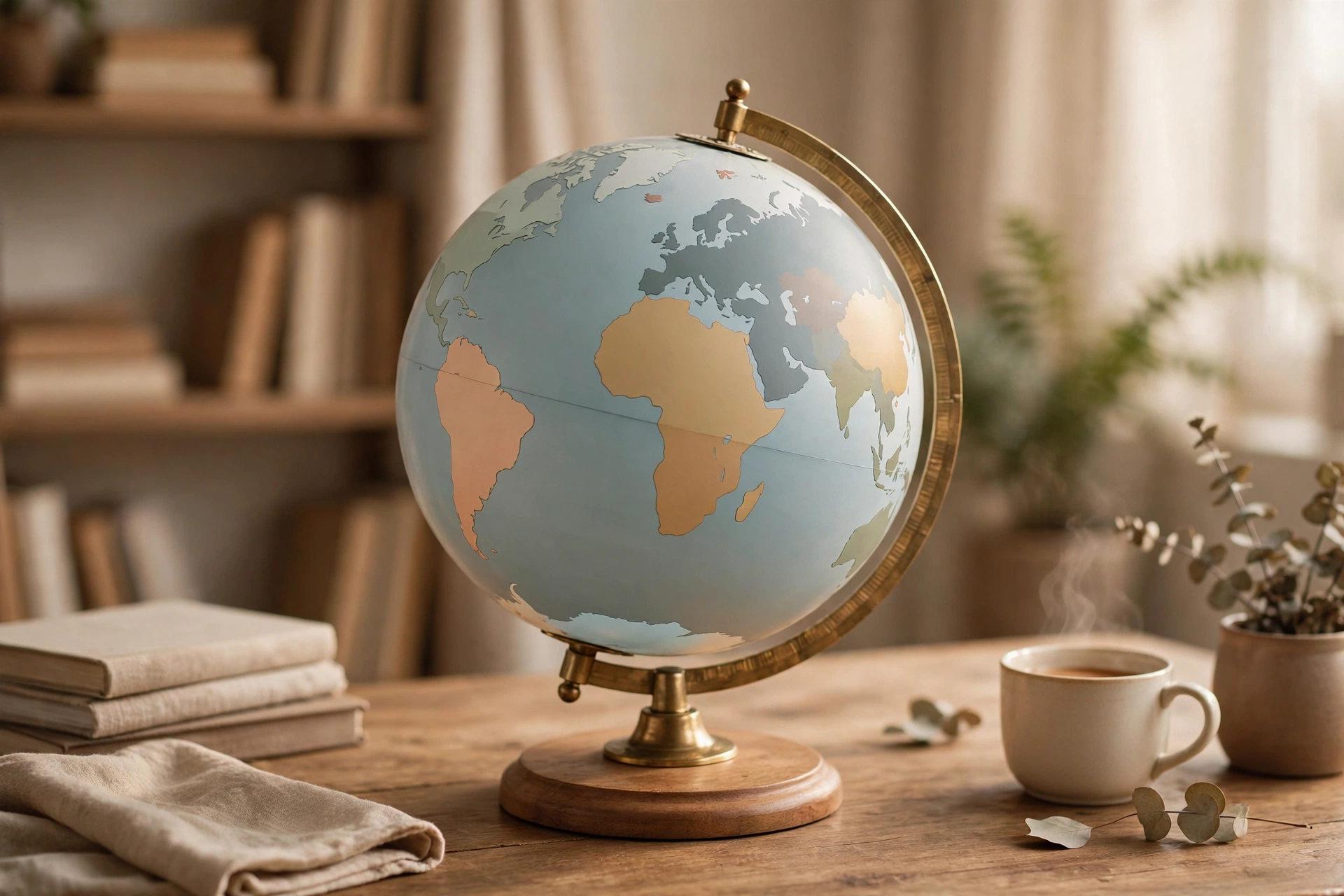
There are 7 continents in the world in the model taught in the UK, the USA, India, China and most English-speaking countries: Asia, Africa, North America, South America, Antarctica, Europe and Australia. But the number is a convention, not a measurement, and other parts of the world honestly teach six or even five. This guide lists the seven continents with their sizes, explains why different counts exist, and answers the question of whether an eighth continent is hiding under the Pacific Ocean.
The 7 Continents, From Largest to Smallest
Asia is by far the largest continent, covering about 44.6 million square kilometres, nearly a third of all the land on Earth, and home to more than half of the world’s people. Mount Everest, the highest point on the planet, stands in Asia, as do the two most populous countries, India and China.
Africa is second at about 30.4 million square kilometres. It is the hottest continent, crossed by the equator, and holds the world’s longest river, the Nile, and its largest hot desert, the Sahara. North America is third at about 24.7 million square kilometres, stretching from the Arctic down to the tropics of Central America. South America follows at about 17.8 million square kilometres, dominated by the Amazon rainforest and the Andes, the longest mountain range on land.
Antarctica, at roughly 14 million square kilometres, is the fifth largest and the odd one out: it has no permanent population at all, only rotating teams of scientists, and it holds most of the world’s fresh water locked up as ice. Europe is second smallest at about 10.2 million square kilometres, small in land but dense in countries and people; it is also the continent most of our travel guides cover, from how many days you need in Paris to the cheapest month to visit London. Australia is the smallest continent at around 7.7 million square kilometres for the mainland mass, often grouped with the Pacific islands as the wider region of Oceania, which brings the total to roughly 8.6 million. Australia is the only continent that is also a single country.
Why Do Some People Count Five or Six Continents?
Because “continent” is partly a cultural idea, and different school systems draw the lines differently. Look at a map and you will see the problem: Europe and Asia are one continuous landmass, separated by mountains and tradition rather than by any ocean, and North and South America are joined by the narrow land bridge of Panama.
One six-continent model therefore merges Europe and Asia into Eurasia. Another, taught in much of Latin America and parts of southern Europe, merges North and South America into a single continent called America. The five-continent model, symbolised by the five rings of the Olympic flag, counts the inhabited parts of the world as Africa, America, Asia, Europe and Oceania, leaving uninhabited Antarctica out entirely. None of these is wrong; each is a different, defensible answer to a question that geography alone cannot settle.
Is There an Eighth Continent?
There is a serious candidate. Zealandia is a vast slab of continental crust, roughly half the size of Australia, lying mostly submerged under the Pacific around New Zealand. Only its highest parts, including New Zealand’s islands and New Caledonia, rise above the sea. Many geologists argue it meets every test for a continent except being dry land, and it is sometimes described as Earth’s eighth continent or as a microcontinent. It has not entered school textbooks yet, but it is the reason scientists answer “how many continents are there?” with a small pause.
And How Many Oceans Are There?
The companion question usually comes with five as its answer: the Pacific, Atlantic, Indian, Southern and Arctic oceans. The Pacific is the giant, larger than all the continents’ land combined, while the Southern Ocean around Antarctica is the newest on the list, only widely recognised in recent decades. Just like the continents, the exact list was agreed by people rather than discovered, and older textbooks often name only three or four oceans, with the Southern Ocean’s waters divided between its bigger neighbours.
So the practical answer for homework, quizzes and crosswords is seven: Asia, Africa, North America, South America, Antarctica, Europe and Australia. Just do not be surprised if a friend from another country learned six, or if a geologist starts talking about the one that sank. The land itself does not change; only the way we choose to divide it does.
