

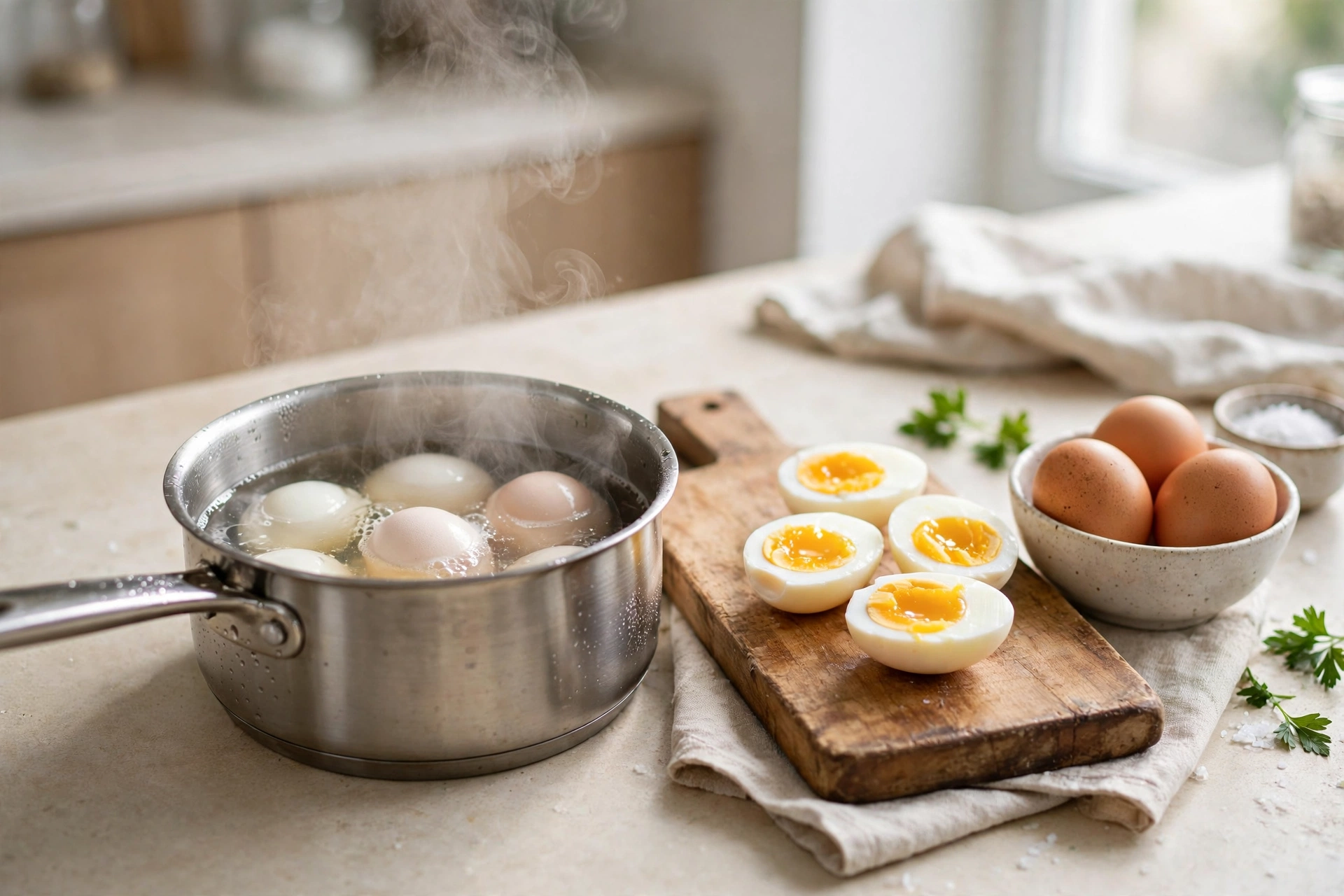
How long to boil an egg depends on how you like the yolk. Using the simplest reliable method, lowering large eggs into already boiling water, the answer is: about 6 minutes for a soft egg with a runny yolk, 7 to 8 minutes for a jammy, medium egg, 10 minutes for a firm egg that is still tender, and 11 to 12 minutes for a fully hard-boiled egg. This guide gives the step-by-step method, explains what changes the timing, and shows how to avoid the grey-green ring and the eggs that refuse to peel.
The Boiling Times at a Glance
All of these times are for large eggs taken straight from the fridge and lowered into water that is already boiling. Start the timer the moment the eggs go in.
For a soft-boiled egg, with a just-set white and a yolk that runs when you cut it, boil for 6 minutes. For a jammy egg, the kind served in ramen, with a glossy, custard-like centre, boil for 7 to 8 minutes. For a medium egg with a yolk that is set but still moist and bright, boil for 9 to 10 minutes. For a hard-boiled egg, firm all the way through for salads, sandwiches and slicing, boil for 11 to 12 minutes. Beyond about 13 minutes you gain nothing and start to lose quality, so treat 12 as the ceiling.
How to Boil an Egg, Step by Step
Bring a pan of water to a rolling boil, using enough water to cover the eggs comfortably. Lower the eggs in gently with a spoon so the shells do not crack against the bottom. Start your timer immediately, and keep the water at a steady boil rather than a violent one.
When the time is up, move the eggs straight into a bowl of cold water, ideally with ice in it, and leave them for at least five minutes. This ice bath does two jobs: it stops the cooking at exactly the point your timer chose, so your 7-minute egg does not quietly become a 9-minute egg, and it makes the shells far easier to peel. Peel under a gentle stream of water if the shell is being stubborn.
What Changes the Boiling Time?
Size is the biggest variable. Medium eggs need roughly a minute less than large ones, and extra-large or jumbo eggs need about a minute more, because heat takes longer to reach the centre. Starting temperature matters too: these times assume eggs from the fridge, and room-temperature eggs will cook a little faster, so shave off around half a minute if yours live in a cupboard.
Altitude changes things in a way few people expect. The higher you live, the lower the temperature at which water boils, so eggs cook more slowly and need extra time. If your results keep coming out underdone and you live well above sea level, add a minute and test one egg before cooking a whole batch.
Why Is There a Green Ring Around the Yolk?
That grey-green ring is harmless, and it has a simple cause: overcooking. When an egg cooks too long or cools too slowly, sulphur in the white reacts with iron in the yolk and paints the ring where they meet. It tastes fine, but it looks tired and the yolk turns chalky. The fix is the method above: do not boil past 12 minutes, and cool the eggs quickly in cold water instead of leaving them sitting in the hot pan.
Peeling Problems and Storage
Very fresh eggs are famously hard to peel, because the white clings to the shell membrane. Eggs that are a week or so old peel much more easily, so buy ahead when you know you will be boiling. Cracking the shell all over and starting at the wider end, where the air pocket sits, also helps. Boiled eggs in their shells keep in the fridge for up to a week; peeled eggs are best eaten within a couple of days.
Boiled eggs are one of the simplest useful foods to master: cheap, filling and ready to take anywhere, and they sit comfortably inside a normal varied diet, as our beginner’s guide to what a balanced diet is explains. Learn your favourite number from the chart, use the ice bath every time, and the results stop being a matter of luck.
