

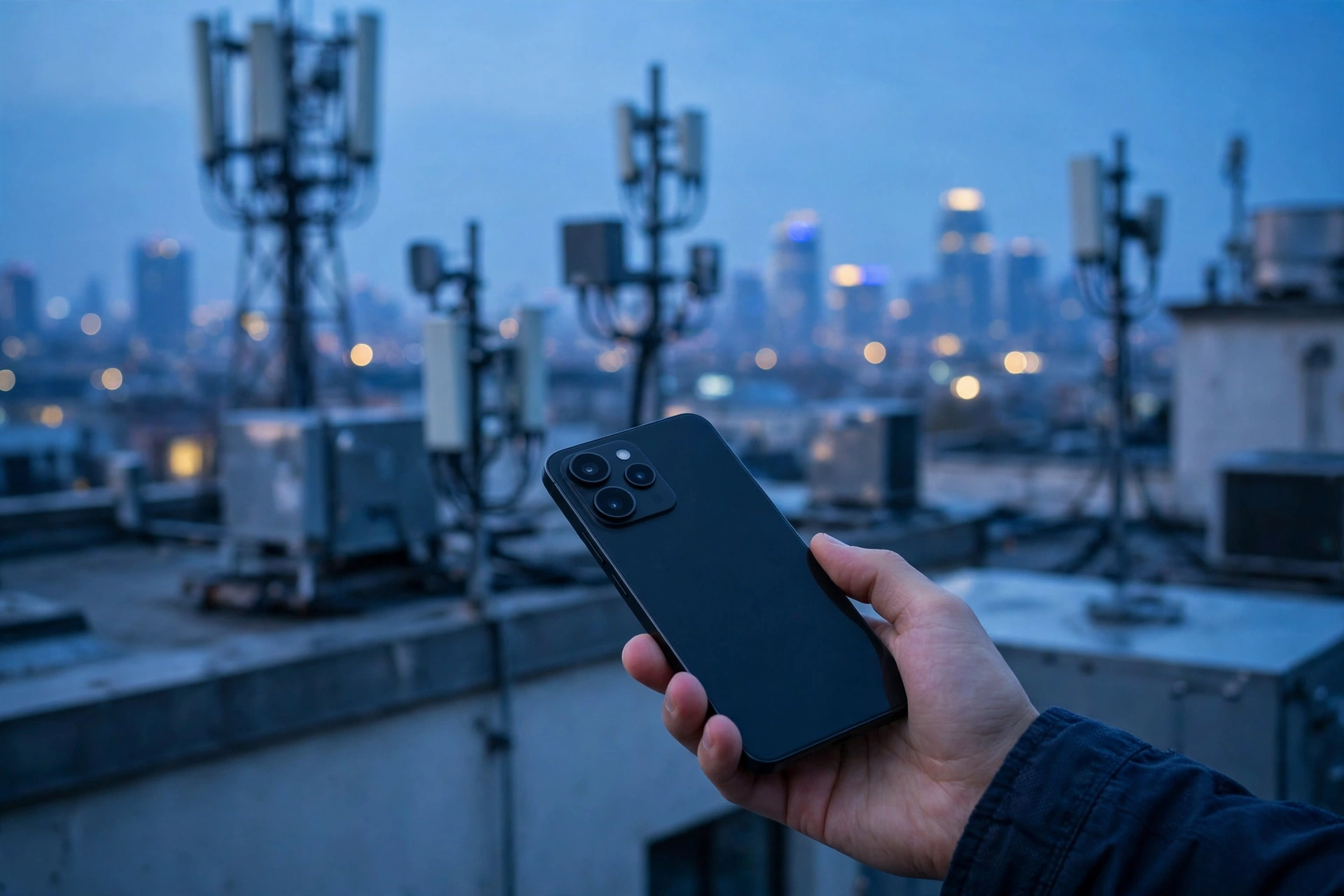
5G is the fifth generation of mobile network technology, the system your phone uses to connect to the internet when you are away from Wi-Fi. It is the successor to 4G, and it was built for three things: faster downloads, a quicker response time, and the ability to connect far more devices at once. The first commercial 5G networks launched in 2019, and the technology has been spreading through cities and towns ever since. This guide explains what 5G is, how it works in plain language, and why the 5G symbol on your phone can mean quite different speeds from one street to the next.
What Is 5G, in Simple Words?
Every generation of mobile network has carried more data, faster: 3G brought basic internet to phones, 4G made streaming video and app-heavy phones normal, and 5G pushes the same idea much further. In theory, 5G can reach download speeds of up to 20 gigabits per second under perfect laboratory conditions. Real life is more modest: typical 5G downloads in many cities are several times faster than 4G rather than twenty times faster, and they vary with signal, distance and how busy the network is.
Just as important is response time, called latency. 4G typically responds in around 30 to 50 milliseconds; 5G can bring that down to around 10 milliseconds or less. You feel that difference in video calls that stay in sync, games that react instantly and pages that start loading the moment you tap.
How Does 5G Work?
Like every mobile network before it, 5G works by sending data as radio waves between your phone and nearby base stations, the masts and rooftop antennas you see around towns. The area around each base station is called a cell, which is why Americans call them cell phones. Your phone hands over from cell to cell as you move, without you noticing.
What is new is the radio technology itself, known as 5G New Radio, and the wider range of frequencies it can use. 5G antennas can also aim signals more cleverly: instead of broadcasting in all directions like a light bulb, modern 5G equipment uses many small antennas together to form focused beams towards individual devices, a technique called beamforming. That wastes less energy and lets one mast serve many more people at full speed. Behind the scenes, a redesigned core network handles the traffic, and can even be sliced into separate virtual networks tuned for different jobs, such as emergency services or a stadium crowd.
The Three Bands of 5G
5G is not one signal but three, and this explains most confusing speed tests. Low-band 5G uses frequencies below 1 GHz. It travels for miles and passes through walls well, but it is only modestly faster than good 4G. Mid-band 5G, roughly between 1 and 6 GHz, is the sweet spot most networks are built on: a good balance of range and speed, often delivering several hundred megabits per second. High-band 5G, called mmWave, uses very high frequencies above 24 GHz. It can be extremely fast over short distances, but it is easily blocked by walls, windows and even heavy rain, so it appears mainly in dense city centres, stations and stadiums.
Your phone connects to whichever band is available, which is why the same phone can show a huge speed test result on one corner and an ordinary one two streets away.
Is 5G the Same as 5 GHz Wi-Fi?
No, and the similar names cause endless confusion. 5G is a mobile network generation. 5 GHz is one of the two radio bands your home router uses for Wi-Fi, the other being 2.4 GHz. They are unrelated technologies that happen to share a number. If your home connection is the one misbehaving, our guide to why your Wi-Fi keeps dropping looks at the router side of things rather than the mobile network.
Do You Need 5G?
You need two things to use it: a 5G-capable phone and a plan and coverage from your network. Most new phones sold today include 5G. For everyday use, 4G still handles calls, messaging, maps and standard video comfortably; 5G earns its keep with large downloads, busy areas where 4G slows down, and as a home broadband alternative in places where fixed lines are poor. Coverage is still patchy outside cities, so check your network’s map before paying extra for it.
In short, 5G is not magic and it is not a single speed. It is a newer, smarter mobile system that uses a wider range of radio waves to move data faster and with less delay. As mid-band coverage fills in, the gap over 4G becomes something ordinary users can actually feel.
